test abeilles
Documents and Presentations of the eleventh EURL Annual Workshop
The annual workshop is the opportunity for the NRL network to exchange, to receive news from the partners and to have information on the activities run in 2021 and the future actions.
Agenda
The agenda can be downloaded here.
Presentations
1. Latest developments and some elements of Animal Health Law and Official Controls Regulation
2. Activities of the NRL and current honeybee health status in Poland
3. Update on the epidemiological situation linked to Aethina tumida in Italy
4. B-GOOD: giving Beekeeping Guidance by cOmputatiOnal-assisted Decision making
5. Diagnostic techniques using Next-Generation Sequencing (NGS) technologies
6. Using whole genome sequencing (WGS) to trace Paenibacillus larvae outbreaks
7. EURL highlights implemented during 2020-2021 and future actions
Minutes
The minutes of the 11th Annual Workshop of the EURL can be found here.
The eleventh EURL annual workshop held on September 2021
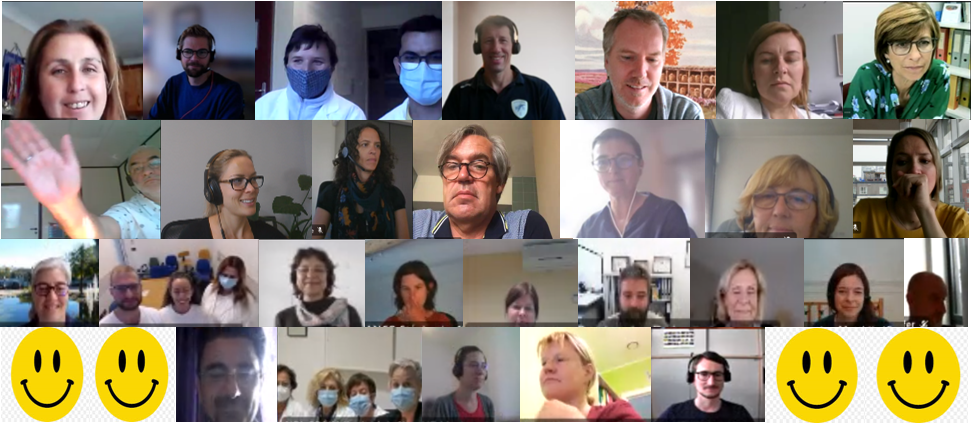
The EURL for Bee Health held its 11th annual workshop on 22nd and 23rd September 2021 by video conference. This workshop was a success with up to 59 participants connected at the same time.
This year, the discussions focused on the American foulbrood and the advantages of new molecular tools for the study and surveillance of this disease. The EURL presented the development of a core genome multilocus sequence typing scheme (cgMLST) for P. larvae (EuroPLarva project), agent of the American foulbrood. Dr. Joakim Skarin from the EURL-Campylobacter, who also participated in this study, presented the diagnostic techniques using Next-Generation Sequencing (NGS) technologies.
Dr. Franco Mutinelli, Head of the Italian NRL, presented a state of play of the occurrence and surveillance of SHB in Southern Italy. Dr. Severine Matthijs, head of the Belgium NRL, gave a talk about the first laboratory results of a field study part of B-GOOD (the Horizon 2020 project). The participants had also the pleasure to listen to a presentation from the Polish NRL representative. Dr. Andrej Bober gave a talk on the Polish NRL activities and the honey bee health status in Poland. The workshop ended by the presentation of the EURL activities during the last period and the work perspectives.
We warmly thank all the speakers for their interesting presentations and all the contributors for the fruitful discussions.
Documents and presentations of the workshop can be found here for the NRL network.
You must be logged in for downloading the report, click on the button below to proceed
Go to login pageEU RL methods & forms
EURL methods
The responsibilities and tasks of European Union Reference Laboratories (EURLs) and of National Reference Laboratories (NRLs) are listed in the Regulation (EU) 2017/625. Additional responsibilities and tasks for the EURL for Bee Health are listed in the Commission Regulation (EU) No 415/2013. The methods used within the European NRLs should follow the rules listed in the Commission Delegated Regulation (EU) 2020/689. In this last regulation, a cascade of methods for sampling, analyses, tests and diagnosis is described in Article 6. Hence, official laboratories and NRLs have to use details and guidance made available on the EURL websites and complying with the Regulation (UE) 2016/429. In the absence of the above, internationally recognised rules or protocols (i.e. WOAH’s Terrestrial Manual) shall be followed. In the absence of the above, nationally recognised rules shall be followed or, if no such rules exist, relevant methods developed or recommended by NRLs shall be used. In the absence of the above, and when analyses, tests or diagnoses are urgently needed, methods other than those above-mentioned can be used until the validation of an appropriate method in accordance with internationally accepted scientific protocols.
Please find below the diagnostic methods related to bee diseases pursuant to Article 6 of the Commission Delegated Regulation (EU) 2020/689.
For the EU listed diseases (pursuant to Commission Implementing Regulation (EU) 2018/1882)
- Tropilaelaps spp.
Morphological identification of Tropilaelaps spp. (adult form) (WOAH method)
Identification of Tropilaelaps spp. using a conventionnal PCR (in-house method) and sequencing
- Aethina tumida
Morphological identification of the Small Hive Beetle (WOAH method)
Identification of the Small Hive Beetle by real time PCR (in-house method)
- Paenibacillus larvae (causative agent of American foulbrood)
Identification of Paenibacillus larvae using PCR (in-house method)
Detection of AFB and EFB agents using real-time PCR (in-house method))
For the other diseases
Bacteriology
- Melissococcus plutonius (causative agent of European foulbrood)
Identification of Melissococcus plutonius using PCR (in-house method)
Virology
- Multi-viruses
Miscellenaous
Test for the presence of the β-actin gene on honeybee samples using PCR (in-house method)
EURL forms
EURL reference material request